


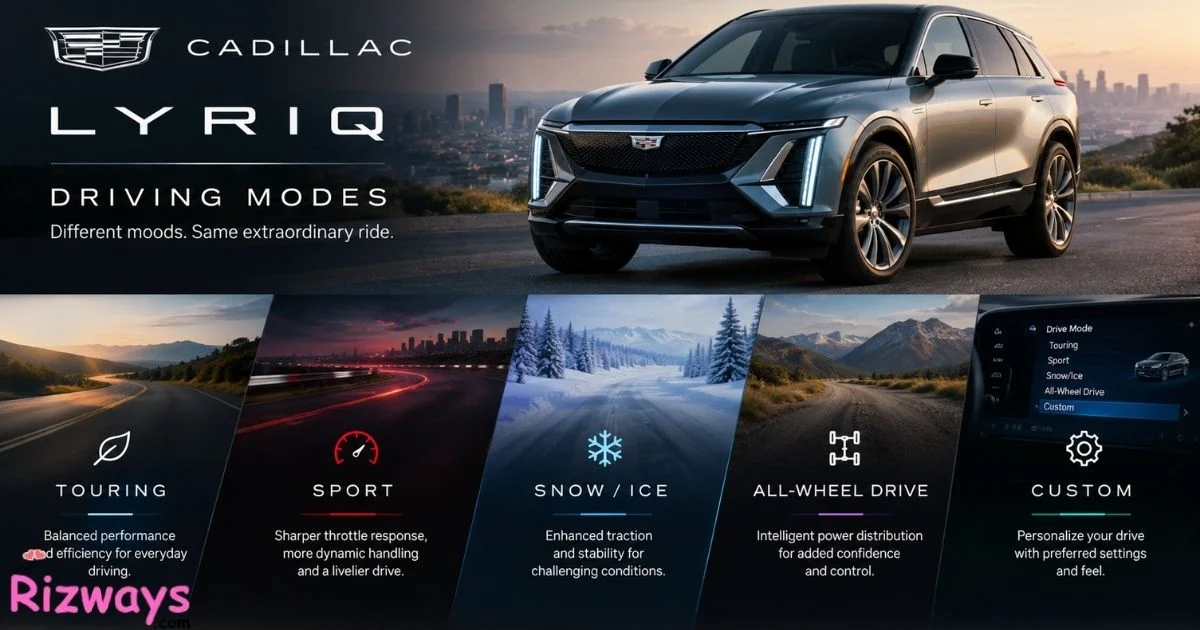
Wondering how Cadillac LYRIQ driving modes affect your driving experience, battery usage, and range? This luxury electric SUV offers selectable drive modes such as Tour mode, Sport mode, Snow/Ice mode, and My Mode, each designed to adjust vehicle response for different driving conditions. The selected mode can influence throttle input, traction, driving behavior, and driving performance, but it is only one part of the bigger picture.
Factors such as speed, temperature, terrain, climate control, road conditions, and driving habits can have a much greater effect on real-world energy consumption and battery range.
In this guide, you’ll learn how each mode works, whether mode selection changes power consumption or efficiency, and what LYRIQ owners should consider for daily driving, longer trips, and trip planning.
Read More: SnapJotz Com Explained I The Truth, Safety & Review 2026
What Is the Cadillac LYRIQ?
The Cadillac LYRIQ is a fully electric luxury SUV from Cadillac and one of the brand’s dedicated battery-electric vehicles. Instead of using a traditional gasoline engine, the LYRIQ uses an electric powertrain powered by a high-voltage battery pack.
The LYRIQ combines a premium interior with modern technology, electric performance, and selectable driving modes designed for different driving situations. Depending on the model year and configuration, drivers can use settings such as Tour, Sport, Snow/Ice, and My Mode to adjust the vehicle’s driving behavior.
Its driving experience can also include regenerative braking, which allows the vehicle to recover some energy during deceleration. Like other EVs, the LYRIQ’s actual range and energy consumption depend on factors such as speed, temperature, terrain, climate control, and driving habits.
For anyone learning about Cadillac LYRIQ driving modes, understanding these basic EV characteristics makes it easier to see how each mode fits into everyday driving.
Cadillac LYRIQ Background and History
The Cadillac LYRIQ was introduced as Cadillac’s first major dedicated all-electric SUV, marking an important step in the brand’s move toward electrification. Cadillac developed the LYRIQ on General Motors’ Ultium electric vehicle platform, which was designed to support a range of battery-powered vehicles.
The LYRIQ entered production for the 2023 model year, giving Cadillac a dedicated electric luxury SUV rather than simply adapting an existing gasoline-powered model. Since its introduction, Cadillac has offered the LYRIQ in different configurations and continued to update its technology, powertrain choices, and available features.
This background is useful when looking at LYRIQ driving modes because the vehicle was designed from the beginning around an electric powertrain. Features such as regenerative braking, selectable drive modes, battery management, and charging therefore play an important role in its overall driving experience.
Understanding the Cadillac LYRIQ’s Driving Modes
The Cadillac LYRIQ uses selectable driving modes to change how the electric SUV responds to different situations. Depending on model year and configuration, the available settings include Tour, Sport, Snow/Ice, and My Mode. These settings are primarily about vehicle response and traction, rather than creating completely different powertrains or battery capacities.
The important point is that a driving mode does not guarantee a specific range. Your energy consumption still depends heavily on speed, temperature, terrain, traffic, climate control, tire conditions, and driving habits. For that reason, the mode that feels most comfortable is not always the mode that produces the lowest energy use.
Tour Mode for Everyday Driving
Tour mode is the natural starting point for daily driving. It is designed around a balanced driving experience, making it suitable for commuting, city streets, and normal highway travel.
For many drivers, Tour is the best default when there is no special road condition to address. It provides a predictable vehicle response without making performance the main priority.
Tour mode can make sense when you want:
- Comfortable, controlled acceleration
- Predictable responses in normal traffic
- A relaxed driving experience
- A balanced setting for commuting and longer trips
It is worth separating comfort from efficiency, however. Choosing Tour does not automatically mean the LYRIQ will use the least electricity on every trip. Throttle input, speed, terrain, temperature, and climate control can have a larger effect on actual power consumption.
Sport Mode for Responsive Performance
Sport mode is intended for drivers who want a more responsive feel from the LYRIQ. Rather than being a separate performance vehicle, it changes the character of the vehicle so acceleration and driver inputs can feel more immediate.
That makes Sport useful when driving performance and responsiveness matter more than a relaxed setup. It can be enjoyable on open roads where you want quicker reactions from the accelerator.
However, selecting Sport does not mean the battery capacity changes or that the LYRIQ suddenly has a different battery. The bigger consideration is how you drive after selecting it. Frequent hard acceleration and higher speed can increase energy consumption, reducing the real-world range you achieve from a charge.
So, Sport mode itself should not be treated as a fixed percentage reduction in range. The actual effect depends on your driving behavior.
Snow/Ice Mode for Slippery Roads
Snow/Ice mode is designed for situations where available traction is reduced, such as roads covered by snow or ice. Its purpose is different from Sport mode: instead of emphasizing responsiveness, it prioritizes a more controlled response when grip is limited.
This distinction matters because electric vehicles can deliver torque quickly. On a slippery surface, smooth inputs can help the tires maintain traction rather than overwhelming available grip.
Snow/Ice mode can be useful when dealing with:
- Snow-covered roads
- Icy surfaces
- Reduced-grip conditions
- Gentle acceleration requirements
The mode cannot overcome poor road conditions indefinitely. Tire condition, tire type, road surface, temperature, and driver inputs still matter. Drivers should therefore treat Snow/Ice as a traction aid, not a substitute for appropriate winter tires or cautious driving.
My Mode for Personalized Settings
My Mode is intended for drivers who want a more personalized setup rather than relying entirely on the predefined driving profiles.
The practical advantage is customization: instead of choosing a mode based only on a broad description such as comfort or sport, you can configure the available settings to suit your preferred driving behavior.
The exact customization options can vary by LYRIQ model year and equipment, so it is better not to assume that every LYRIQ provides identical My Mode settings. Check the vehicle’s current owner documentation or infotainment menus for the options available in your specific vehicle.
My Mode is therefore less about maximizing battery range automatically and more about creating a driving setup that matches your preferences.
How Driving Modes Affect Energy Consumption
Do Cadillac LYRIQ driving modes directly determine how much battery the vehicle uses? Not by themselves.
A selected mode can influence vehicle response, but total energy consumption is affected by many variables. The relationship is easier to understand this way:
| Factor | Possible effect on energy use |
| Driving mode | Changes vehicle behavior and response |
| Speed | Higher speeds generally require more energy |
| Throttle input | Aggressive acceleration can increase consumption |
| Temperature | Cold or hot conditions can reduce efficiency |
| Climate control | Heating and cooling consume electrical energy |
| Terrain | Hills and elevation changes can increase demand |
| Traffic | Frequent acceleration and braking affect efficiency |
| Driving habits | Smooth, consistent driving can improve efficiency |
This is why the EPA-rated range should not be treated as a guaranteed distance for every journey. EPA testing provides a standardized comparison, while your actual range depends on real-world conditions.
A useful content gap is the assumption that switching modes produces a precise, predictable range change. In reality, there is no universal number that can be applied to every driver or trip. A LYRIQ traveling at steady highway speed in mild weather can have a very different energy efficiency outcome from the same vehicle driving short trips in extreme temperatures.
Choosing the Right Mode for Better Range
If your priority is efficiency, there is no need to choose a mode simply because its name sounds economical. A better approach is to select the mode that fits the road conditions, then focus on the factors that have the biggest influence on electricity use.
For normal daily driving, Tour is a sensible starting point. When you need stronger responsiveness, Sport can provide a different driving experience. On slippery roads, Snow/Ice is the more appropriate choice. My Mode can work when you want to personalize the vehicle’s behavior.
For longer trips and trip planning, pay closer attention to the conditions affecting your expected range:
- Keep highway speed reasonable and consistent.
- Avoid unnecessary aggressive throttle input.
- Consider how temperature may affect battery performance.
- Account for hills and other changes in terrain.
- Use climate control thoughtfully.
- Watch the LYRIQ’s energy-consumption information during the trip.
The key takeaway is simple: driving mode is only one part of EV efficiency. Your selected mode influences how the LYRIQ behaves, while speed, weather, terrain, climate use, and driving habits largely determine how much energy the trip actually requires.
How Driving Modes Impact Battery Usage and Range
Cadillac LYRIQ driving modes can influence battery usage and range, but the effect is not as simple as choosing one mode and gaining or losing a fixed number of miles. The selected mode mainly changes vehicle response, while actual energy consumption depends on how the vehicle is driven and the conditions around it.
For example, Sport mode may encourage quicker acceleration and more energetic driving, which can increase electricity use when you make frequent hard throttle inputs. By contrast, a smooth driving style in Tour mode may help support better efficiency. That does not mean Tour automatically delivers a specific range advantage.
Several factors can have a larger impact on the LYRIQ’s real-world range, including:
- Driving speed, particularly sustained highway speeds
- Temperature and weather conditions
- Terrain, including steep climbs
- Climate control use for heating or cooling
- Traffic and repeated acceleration
- Tire condition and road surface
- Individual driving habits
The EPA-rated range provides a standardized reference, but it should not be treated as the exact distance every LYRIQ will travel on a full battery. For accurate trip planning, consider the selected mode alongside current energy consumption and the conditions expected during the journey.
In short, driving modes can affect how efficiently the LYRIQ is driven, but battery capacity does not change when you switch modes. Your driving behavior and environmental conditions largely determine how much energy the vehicle actually consumes.
Tour Mode and Battery Efficiency
Tour Mode is a balanced choice for normal driving, but it should not be treated as a dedicated battery-saving mode. It can support a comfortable and predictable driving experience for commuting and highway trips without encouraging a performance-focused driving style.
The bigger factor is how you operate the LYRIQ. Smooth acceleration, steady speeds, and moderate use of climate control can help reduce unnecessary energy consumption. So, while Tour Mode can be a sensible starting point for efficiency, your driving habits have a major influence on the final battery range.
Sport Mode and Battery Consumption
Sport Mode changes the LYRIQ’s driving character toward a more responsive feel. If you make stronger throttle inputs and accelerate more aggressively, the electric motors can demand more energy from the battery.
However, Sport Mode does not automatically cause a fixed loss of range. The difference depends on driving behavior. Using Sport Mode occasionally while maintaining a steady speed may have a smaller effect than repeatedly accelerating hard.
For drivers focused on energy efficiency, the important distinction is between the selected mode and the way that mode is used.
Snow/Ice Mode and Energy Usage
Snow/Ice Mode is designed for situations where traction is more difficult to maintain, such as snow-covered or icy roads. Its purpose is to provide a more appropriate vehicle response for reduced-grip conditions rather than maximize range.
Cold weather itself can be a significant consideration for an EV. Low temperatures can affect battery performance, while heating the cabin can also increase electrical demand. As a result, a winter trip in Snow/Ice Mode may use more energy than a similar trip in mild weather, even if the driving mode is not the primary reason.
My Mode and Driving Efficiency
My Mode allows drivers to personalize the LYRIQ’s available driving characteristics. This can make the vehicle feel better suited to individual preferences, but customization does not automatically translate into lower power consumption.
If efficiency is your priority, the useful approach is to create a setup that encourages smooth and controlled driving. Keep in mind that the available adjustments can vary by model year and configuration, so owners should confirm the specific options in their vehicle.
Ultimately, speed, acceleration, terrain, temperature, and driving habits remain important range factors regardless of the selected My Mode settings.
One-Pedal Driving and Battery Regeneration
One-Pedal Driving allows the accelerator pedal to play a larger role in both acceleration and deceleration. When the driver lifts off the accelerator, the LYRIQ can use regenerative braking to slow the vehicle and send some recovered energy back to the battery.
This can be useful in city traffic because the driver can manage many speed changes without repeatedly moving between the accelerator and brake pedal. However, regeneration does not recover all the energy used to move the vehicle. There are unavoidable conversion and drivetrain losses.
Therefore, One-Pedal Driving can support efficient driving, but it should not be described as a guaranteed way to increase the LYRIQ’s range.
Regen on Demand and Energy Recovery
Regen on Demand gives the driver additional control over regenerative deceleration. Instead of relying entirely on the brake pedal, the driver can request regeneration to slow the vehicle and recover some kinetic energy.
This is particularly useful when approaching traffic or a lower-speed section of road and you want to reduce speed without immediately applying the conventional brakes.
The important point is that energy recovery is not the same as free energy. Regeneration can return part of the vehicle’s kinetic energy to the battery, but some energy is lost during the conversion process. For the best overall EV efficiency, regenerative braking works alongside smooth acceleration, sensible speeds, and careful trip planning rather than replacing them.
Additional Factors Affecting Range and Battery Usage in the LYRIQ
The selected driving mode is only one part of the Cadillac LYRIQ’s range and battery usage. Real-world energy consumption can change considerably based on how, where, and when you drive. Understanding these factors gives you a more realistic idea of what to expect from the LYRIQ than relying on the EPA-rated range alone.
Driving Speed and Battery Usage
Speed is one of the most important factors affecting an electric vehicle’s energy consumption. As speed increases, aerodynamic resistance also rises, requiring more energy to keep the LYRIQ moving.
This means a steady highway trip at a higher speed can use more electricity than slower urban driving. If maximizing battery range matters, maintaining a consistent and reasonable speed can help reduce unnecessary energy demand.
Outside Temperature and Range
Outside temperature can influence both battery performance and cabin energy use. Very cold conditions can reduce an EV’s available efficiency, while heating the cabin adds another electrical load.
Hot weather can also affect efficiency, particularly when the climate control system works harder to keep the cabin comfortable. As a result, the same LYRIQ may deliver different real-world range in summer and winter conditions.
Terrain and Energy Consumption
Terrain plays an important role in energy consumption. Driving uphill requires additional energy because the vehicle must gain elevation. Repeated climbs can therefore increase electricity use during a trip.
Downhill sections can allow the LYRIQ’s regenerative braking system to recover some energy, but regeneration does not return all the energy used to climb. For routes with significant elevation changes, terrain should be considered when estimating range and planning charging stops.
Acceleration and Driving Habits
Your driving habits can have a noticeable effect on EV efficiency. Frequent hard acceleration requires more power from the battery than smooth, gradual inputs.
For better driving efficiency, focus on:
- Accelerating smoothly when conditions allow
- Avoiding unnecessary rapid speed changes
- Maintaining a consistent speed
- Using regenerative braking effectively
- Anticipating traffic so you can slow down smoothly
This also explains why two LYRIQ drivers can achieve different energy-consumption figures on similar routes.
Climate Control and Battery Drain
Climate control uses electricity from the vehicle’s battery. Heating can be particularly important in cold weather, while air conditioning adds electrical demand in hot conditions.
Short trips can make this effect more noticeable because the cabin may require substantial heating or cooling relative to the distance traveled. If you’re planning a longer trip, keeping the cabin temperature at a reasonable setting can help manage overall energy use.
Tire Pressure and Driving Efficiency
Correct tire pressure is another basic but important part of efficient EV operation. Underinflated tires can increase rolling resistance, requiring more energy to move the vehicle.
For that reason, LYRIQ owners should check tire pressures regularly and follow the pressure specifications provided for their vehicle rather than using a generic target. Properly maintained tires support predictable handling, safety, and driving efficiency, while also helping avoid unnecessary energy consumption.
Optimizing Battery Usage for Long-Term Health
The Cadillac LYRIQ’s high-voltage battery is designed for repeated use, but thoughtful charging and temperature management can help you use the vehicle efficiently over time. Battery care is not about following complicated rules. It is mainly about using the charging system as intended, avoiding unnecessary exposure to harsh conditions, and paying attention to the vehicle’s charging guidance.
Maintaining an Optimal Charge Level
For everyday use, follow the charge-limit recommendations available in your LYRIQ rather than keeping the battery at a very high state of charge without a practical reason. If you only need enough energy for commuting, there is usually little benefit in charging far beyond what your next trip requires.
For longer journeys, charging to a higher level can make sense because additional battery range provides more flexibility between charging stops. The key is to match the charge level to your actual driving needs.
Using DC Fast Charging Wisely
DC fast charging is valuable when you need to add a substantial amount of energy during a road trip. It can make long-distance travel more practical by reducing the time spent stopped for charging.
For routine charging, however, owners can generally use the charging method recommended for their situation rather than relying on fast charging for every session. Charging speed can also vary depending on factors such as battery temperature, state of charge, charger capability, and vehicle conditions.
There is no need to avoid DC fast charging entirely. The more useful approach is to use it when its speed provides a real benefit.
Avoiding Extreme Temperatures
Temperature affects EV battery operation and charging. Very hot or cold conditions can change charging performance and overall energy efficiency.
When practical, parking and charging in a more temperature-controlled environment can reduce exposure to extreme conditions. The LYRIQ’s battery-management system also helps regulate the high-voltage battery, so owners should rely on the vehicle’s built-in systems rather than attempting to manually control battery temperature.
Following Recommended Charging Habits
The best charging routine is one that follows the Cadillac LYRIQ owner’s guidance and fits your daily driving needs. Avoid creating unnecessary charging cycles simply because the vehicle is available to plug in.
For everyday use, consider:
- Setting an appropriate charging limit for your typical trips.
- Charging ahead of longer journeys when additional range is needed.
- Using scheduled charging when it fits your routine.
- Following the vehicle’s warnings and charging instructions.
- Using compatible, properly installed charging equipment.
Charging habits should be practical rather than based on rigid rules about a particular percentage.
Monitoring Battery Performance
Pay attention to the LYRIQ’s energy consumption, charging behavior, and estimated range over time. A temporary reduction in estimated range does not automatically indicate battery degradation because temperature, speed, terrain, climate control, and recent driving conditions can all change the estimate.
Look for persistent changes rather than judging battery health from a single trip. If you notice unusual charging behavior, repeated warnings, or another issue that does not resolve, the appropriate step is to consult Cadillac service information or a qualified technician.
Planning Efficient Long-Distance Trips
Good trip planning can reduce range anxiety and make longer journeys easier. Before leaving, consider your route, expected weather, terrain, traffic, and available charging locations.
For a long trip in the LYRIQ:
- Start with enough charge for the planned route and a reasonable buffer.
- Identify compatible charging stops before departure.
- Consider how speed and temperature may affect real-world range.
- Allow extra energy for detours, traffic, or unexpected conditions.
- Use the vehicle’s navigation and charging information where available.
Most importantly, don’t plan a trip solely around the LYRIQ’s EPA-rated range. That figure provides a standardized reference, while your actual range depends on the conditions you encounter.
Practical Tips to Stretch Your Range
If you want to get more miles from each charge, focus less on constantly changing driving modes and more on the factors that directly affect EV efficiency. These simple habits can help reduce unnecessary energy consumption during everyday and long-distance driving:
- Keep speeds steady: Higher speeds generally require more energy, so maintaining a consistent, moderate speed can help preserve battery range.
- Accelerate smoothly: Gradual throttle input reduces unnecessary power demand compared with repeated hard acceleration.
- Use regenerative braking: Take advantage of regenerative braking when slowing down to recover some kinetic energy.
- Check tire pressure: Properly inflated tires can reduce rolling resistance and support better driving efficiency.
- Manage climate control: Heating and cooling draw electricity from the battery, so use climate control thoughtfully when range is a priority.
- Consider weather conditions: Very hot or cold temperatures can affect real-world range, so allow extra margin when planning trips.
- Plan charging stops: For longer journeys, identify charging locations ahead of time instead of relying entirely on the vehicle’s estimated remaining range.
- Choose the right driving mode: Use Tour Mode for normal driving, Sport Mode when responsiveness matters, and Snow/Ice Mode when road conditions require additional traction support.
- Watch energy consumption: The LYRIQ’s energy-use information can help you identify whether speed, terrain, or driving habits are increasing electricity use.
- Leave a sensible buffer: Avoid planning a long trip around the absolute maximum estimated range. A reserve gives you more flexibility if traffic, temperature, terrain, or detours increase energy demand.
Cadillac LYRIQ at a Glance
| Feature | Cadillac LYRIQ |
| Vehicle type | Fully electric luxury SUV |
| Brand | Cadillac |
| Manufacturer | General Motors |
| Powertrain | Battery-electric |
| Platform | GM Ultium platform |
| First model year | 2023 |
| Energy source | High-voltage battery |
| Driving modes | Tour, Sport, Snow/Ice, and My Mode, depending on configuration |
| Regenerative braking | Available |
| Charging | AC charging and DC fast charging |
| Range | Varies by model year, trim, drivetrain, and configuration |
| Key range factors | Speed, temperature, terrain, climate control, tires, and driving habits |
| Primary focus | Luxury, technology, comfort, and electric performance |
Note: Features and available driving modes can vary by LYRIQ model year and configuration, so readers should verify specifications for the specific vehicle they are considering.
How to Change Drive Mode on Cadillac Escalade
Changing the drive mode on a Cadillac Escalade is straightforward, although the exact controls can vary by model year and trim level. Start the vehicle and locate the Drive Mode Selector in the center-console area. Turn or press the selector to cycle through the available driving modes, then select the setting shown on the vehicle display.
Depending on the Escalade configuration, available modes may include settings designed for normal driving, sportier response, towing, or reduced-traction conditions.
Before switching modes, keep the vehicle under control and choose a setting that matches the current road conditions and driving needs. For the exact procedure and available modes on your Escalade, check the owner’s manual for your specific model year and configuration.
Conclusion
Understanding Cadillac LYRIQ driving modes can help you choose a setting that matches your road conditions and driving preferences. Tour Mode suits everyday travel, Sport Mode emphasizes responsiveness, Snow/Ice Mode is designed for reduced traction, and My Mode provides personalization. One-Pedal Driving and Regen on Demand offer additional ways to manage deceleration and regenerative braking.
However, the selected mode is only one part of the range equation. Speed, temperature, terrain, acceleration, tire pressure, climate control, and driving habits can all influence battery usage and real-world range. For the best results, choose the mode that fits the situation and focus on smooth, efficient driving.
Frequently Asked Questions
Which driving mode is best for the Cadillac LYRIQ?
Tour Mode is a practical choice for normal daily driving because it provides a balanced driving experience. The best mode ultimately depends on road conditions and your preferred vehicle response.
Does Sport Mode reduce LYRIQ range?
Sport Mode can contribute to higher energy consumption when it encourages stronger acceleration or more aggressive driving. However, there is no universal fixed range reduction caused by selecting Sport Mode.
Does Snow/Ice Mode use more battery?
Snow/Ice Mode is designed to help manage slippery road conditions rather than maximize efficiency. Winter temperatures, road surfaces, tires, cabin heating, and driving behavior can have a greater effect on battery usage.
Does changing driving modes affect battery capacity?
No. Switching between available driving modes does not change the physical battery capacity of the LYRIQ. The modes primarily alter vehicle behavior and response.
Does One-Pedal Driving improve LYRIQ range?
One-Pedal Driving uses regenerative braking to recover some energy during deceleration. It can support efficient driving, but it does not guarantee a specific increase in range.
What affects LYRIQ real-world range the most?
Speed, outside temperature, terrain, acceleration, climate control, tire pressure, traffic, and driving habits can all affect real-world range. These factors can make actual range different from the EPA-rated figure.
Which LYRIQ mode should I use for long trips?
Tour Mode is a sensible choice for relaxed everyday and highway travel, but efficient long-distance driving depends more on maintaining reasonable speeds, smooth acceleration, managing climate control, and planning charging stops.
Can I use Sport Mode every day?
Yes, if it suits your driving preferences and conditions. However, frequent aggressive acceleration in Sport Mode can increase energy consumption, so drivers prioritizing maximum range may prefer a smoother driving style.
