


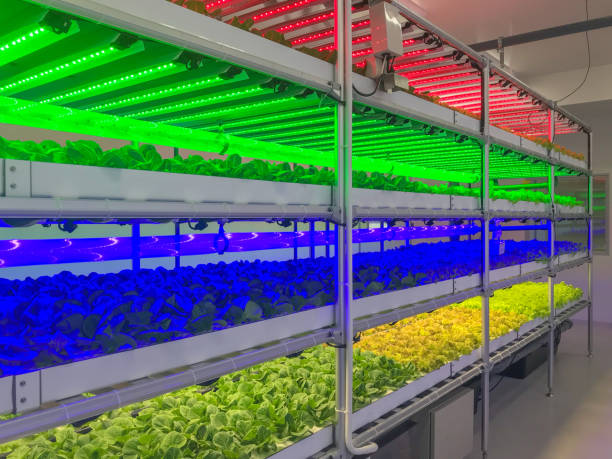
Commercial agriculture is undergoing a major transformation. Driven by climate volatility, supply risks, and demand for local produce, Controlled Environment Agriculture (CEA) has expanded from greenhouses into vertical farms.
Yet for growers and agri-tech founders, scaling begins with a financial crossroads: do you capture sunlight in a greenhouse, or deploy multi-tier LED racks in a warehouse?
Sunlight provides free energy, but greenhouses require acreage, glazing, and seasonal climate control. Vertical LED racks offer space efficiency and biological control, but demand heavy electrical power and upfront capital.
Choosing the right system is a financial decision governed by CapEx, OpEx, and harvest economics. Here is how to budget LED racks versus sunlight for your commercial growing operation.
1. The Core Trade-Off: Upfront CapEx vs. Ongoing Energy OpEx
The quick answer: Greenhouses harness free sunlight to cut power costs but require more land, while vertical LED farms save real estate at the expense of high recurring electric bills.
The financial distinction between vertical farms and greenhouses lies in capital allocation:
- LED Vertical Racks: Stacking crops eight to twelve layers high minimizes land footprint, but powering commercial fixtures represents 30% to 50% of ongoing operating costs.
- Greenhouses: Solar photons are free, but greenhouses demand substantial controlled environment agriculture CapEx for structural steel, ground site work, and glazing.
Budgeting requires deciding whether your balance sheet better handles heavy upfront structural costs or recurring electric bills.
2. Photon Economics: Matching Crop DLI to Growing Medium
The quick answer: Low-light crops like leafy greens thrive under indoor LED racks, whereas high-light fruiting crops like tomatoes become cost-prohibitive without sunlight.
Every crop has specific daily light integral requirements (DLI)—the photon volume delivered per square meter daily:
- Leafy Greens & Herbs (12–16 mol/m²/day): Lettuce and herbs require modest DLI. Delivering this via LEDs is viable because fast 25-day cycles yield high revenue per kilowatt-hour.
- Fruiting Crops (25–35+ mol/m²/day): Tomatoes and peppers require intense photon density. Supplying this entirely through artificial fixtures inflates power costs beyond wholesale crop value.
Farms focusing on vine crops almost universally choose greenhouses where sunlight covers the bulk of photon demand.
3. The Thermal Reality: HVAC Cooling Loads vs. Greenhouse Heating
The quick answer: Indoor LED racks generate heat requiring heavy air conditioning and dehumidification, whereas greenhouses face exterior climate swings and winter heating bills.
A common mistake is assuming LEDs emit zero heat. While fixtures emit minimal infrared radiation toward canopies, 50% to 60% of electrical input converts into room heat.
In a warehouse, thousands of stacked LED bars generate heavy thermal loads while crop transpiration saturates humidity. Facilities require industrial HVAC chillers running 24/7 to manage climate parameters.
Greenhouses, by contrast, act as solar collectors. Summer requires cooling pads and automated vents, while northern winters demand boiler systems to heat uninsulated glass.
4. Location Economics and Real Estate Footprints
The quick answer: Vertical LED systems fit into urban industrial facilities near distribution hubs, whereas greenhouses require horizontal acreage outside city centers.
Your distribution model directly shapes real estate budgets:
- Urban Vertical Warehouses: Multi-layer racking generates 10 to 20 times the yield per square foot of floor space. Facilities can locate in industrial parks near city centers, reducing refrigerated transport costs to grocers.
- Peri-Urban Greenhouses: Greenhouses demand flat, unshaded acreage. Finding multi-acre parcels near cities is costly, requiring operators to budget for rural land, utility extensions, and longer transit routes.
5. The Hybrid Alternative: Dynamic Supplemental Lighting
The quick answer: Hybrid greenhouses use sensor-controlled LEDs that activate only when cloud cover drops solar radiation below optimal thresholds.
Agronomy does not require choosing exclusively between sun and LEDs. Modern facilities increasingly adopt hybrid models.
By evaluating greenhouse supplemental lighting efficiency, growers use sensors to track natural solar radiation in real time. On bright days, LEDs remain off. When winter days shorten or clouds roll in, dimmable top-lights ramp up to maintain consistent DLI, pairing vertical farm consistency with greenhouse solar savings.
6. Financing CEA Facilities Without Exhausting Reserves
The quick answer: Equipment leasing allows farms to acquire lighting, automated racking, and climate controls while preserving liquid operating reserves.
Hardware represents the bulk of CEA startup capital. Purchasing LED fixtures, fertigation skids, and HVAC systems outright drains reserves before your first harvest generates revenue.
Experienced operators utilize structured commercial leasing to finance lighting, automation, and racking. Spreading equipment outlays over predictable monthly terms aligns capital expenses with ongoing crop sales, protecting working capital for seeds, packaging, and payroll.
7. The CEA Capital Budgeting Checklist
Before finalizing facility plans, audit these metrics:
- [ ] Power Tariffs: Confirm industrial kilowatt-hour electric rates and peak demand charges.
- [ ] Target Crop DLI: Match daily photon requirements against expected revenue.
- [ ] HVAC Sizing: Model heat dissipation from LED drivers alongside crop transpiration.
- [ ] Real Estate: Compare industrial warehouse leasing with rural land development costs.
- [ ] Capital Strategy: Lock in equipment financing to protect liquid reserves.
Budgeting for commercial indoor agriculture requires looking beyond the appeal of free sunlight or vertical LED racks. Long-term profitability depends on the intersection of crop biology, energy tariffs, real estate costs, and capital structure. Leafy greens thrive under vertical LED racking near urban markets, while fruiting crops benefit from greenhouse sunlight. Modeling capital outlays, evaluating thermal HVAC loads, and securing structured financing ensures your growing operation remains profitable for years to come.
Read more: https://rizways.com/electrical-readiness-for-a-new-hvac-system-what-to-verify-before-installation/
https://rizways.com/when-your-ac-blows-warm-air-safe-first-hour-checks-that-help-a-technician/
https://rizways.com/how-dental-equipment-financing-rates-can-make-or-break-your-investment-strategy/

Pingback: How to Handle a Dental Emergency Days Before Your Ceremony