


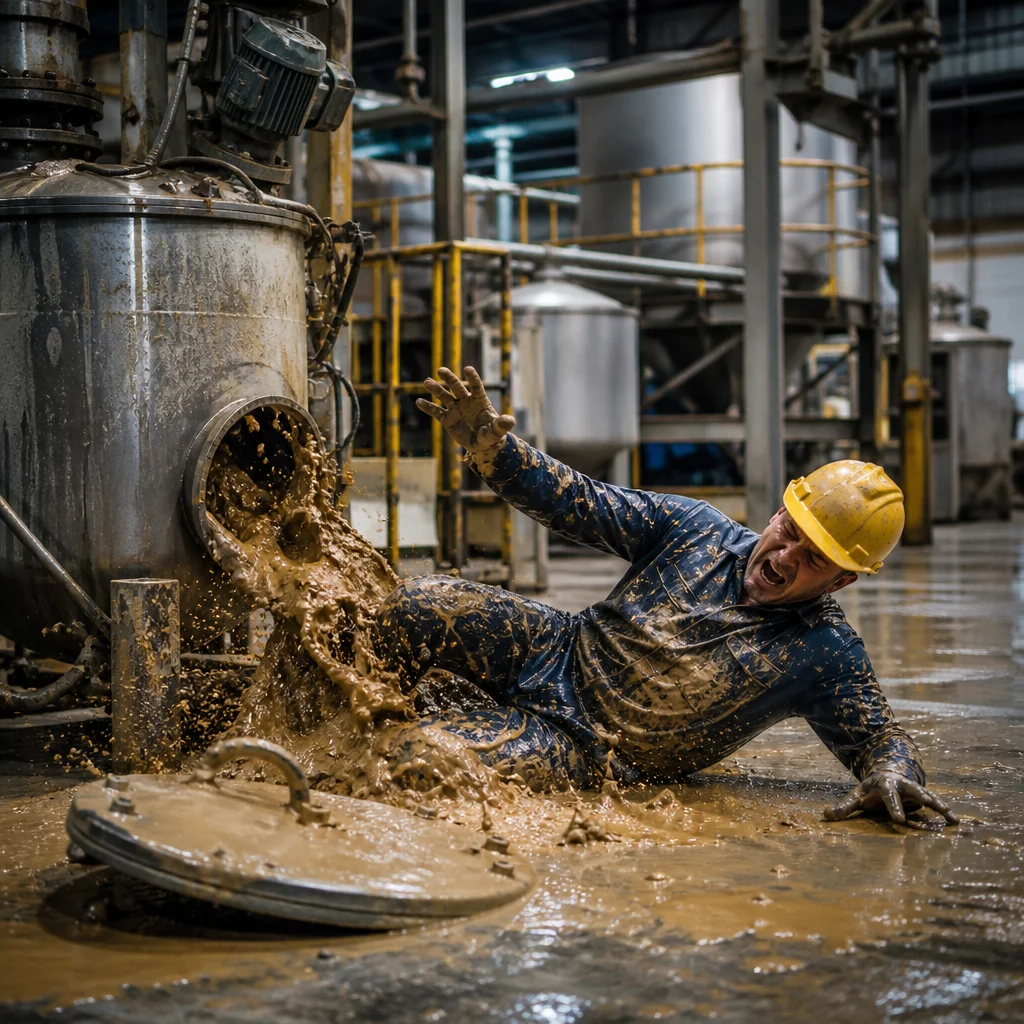
Poor mixing in industrial reactors causes more than just quality problems. When materials don’t blend properly, chemical reactions behave unpredictably, temperatures spike in localized zones, and operators face hazards that turn routine production into emergency response. The connection between inadequate agitation and workplace accidents is well documented, yet many facilities continue operating with equipment that cannot deliver the mixing performance their processes demand.
Understanding this relationship matters for anyone responsible for process safety, equipment specification, or production operations. The right mixing equipment prevents incidents before they start, while the wrong choice creates conditions where even experienced staff cannot maintain safe operation.
Temperature Excursions From Inadequate Heat Transfer
Exothermic reactions generate heat that must be removed continuously to prevent runaway conditions. When agitators cannot circulate fluid effectively past heat exchange surfaces, hot spots develop despite jacket cooling or internal coils operating at full capacity. These localized temperature excursions accelerate reaction rates in unpredictable ways, consuming reactants faster than feed systems can compensate and producing off-specification intermediates that may decompose violently.
The problem compounds in viscous systems where inadequate impeller design creates stagnant zones. Material trapped away from cooling surfaces continues reacting while the bulk temperature reading suggests normal operation. By the time thermal sensors detect the problem, pressure has already built beyond relief capacity or decomposition has progressed past the point where standard quench procedures work effectively.
Phase Separation and Unstable Emulsions
Multiphase systems require consistent shear and turbulence to maintain stable dispersions. When agitation fails to meet this requirement, heavier phases settle while lighter materials float, creating layers with drastically different chemical properties. Operators who sample from a single point receive misleading information about vessel contents, making decisions based on data that doesn’t represent the actual process state.
Attempting to remix separated phases often proves more dangerous than the initial inadequate mixing. Restarting agitation in a stratified vessel can suddenly expose previously isolated materials to each other, triggering reactions that release energy faster than the vessel was designed to handle. This scenario has caused multiple documented incidents where batch segregation went unnoticed until aggressive remixing initiated uncontrolled reactions.
Selecting Agitation Systems That Match Process Demands
Preventing mixing-related safety incidents requires matching agitator design to specific process characteristics. Fluid viscosity, density differences between phases, required heat transfer rates, and reaction kinetics all dictate which impeller geometries and motor specifications will provide adequate performance. Facilities upgrading equipment or changing processes need detailed analysis of these factors rather than simply replacing old agitators with similar models.
Different reactor agitator types address distinct mixing challenges, from high-shear dispersers for emulsification to low-shear hydrofoils for gentle blending of temperature-sensitive materials. Companies sourcing used equipment can achieve significant capital savings when they work with suppliers who understand these application requirements and stock reactors with appropriate mixing configurations already installed. This approach reduces both upfront costs and the time required to validate that new equipment will perform safely in existing processes.
Power Input and Turnover Rate
Adequate mixing requires sufficient power to circulate the entire vessel contents within a time frame appropriate to the reaction or blend being performed. Rules of thumb exist for various applications, but actual requirements depend on factors including vessel geometry, baffle configuration, and whether the process involves mass transfer between phases or simple blending of miscible liquids.
Undersized motors save money initially but cannot deliver the tip speeds and flow patterns needed for complete mixing. The result is dead zones where material ages differently than the rest of the batch, creating composition gradients that affect both safety and quality. Operators compensating for weak agitation by extending batch times expose materials to thermal history that degrades products or increases the risk of secondary reactions.
Human Factors in Mixing-Related Incidents
Even well-designed mixing systems fail when procedures don’t account for equipment limitations or operators lack training on recognizing inadequate agitation. Visual inspection through sight glasses reveals surface motion but provides no information about circulation near the vessel bottom or behind baffles. Temperature and pressure instruments offer indirect evidence of mixing quality, yet interpreting these signals requires understanding how readings should behave during normal operation.
Facilities that treat agitator maintenance as low priority create conditions where mechanical problems develop into safety hazards. Worn seals allow air ingress into processes that should remain oxygen-free, while damaged impeller blades reduce pumping capacity without triggering obvious alarms. The gradual nature of this degradation means operators adapt to declining performance rather than recognizing it as a precursor to more serious failures. Some teams cope with these situations through humor, but as various safety jokes illustrate, laughing about near misses doesn’t prevent the next incident from causing actual harm.
Computational Modeling and Scale-Up Challenges
Modern computational fluid dynamics tools can predict mixing performance before equipment is installed, revealing potential dead zones and inadequate heat transfer that would otherwise appear only during commissioning or production. These simulations require accurate input data about fluid properties and boundary conditions, but when properly executed they identify problems that traditional scale-up correlations miss.
Research into mixing and reactor design continues advancing understanding of how flow patterns affect both safety and productivity. Laboratory results don’t always translate directly to production scale, particularly when fluid rheology changes with concentration or temperature. Pilot campaigns that measure mixing times, temperature uniformity, and reaction selectivity under conditions matching full-scale operation provide validation that computer models and bench work cannot replace.
Documentation and Change Management
Accurate records of agitator specifications, maintenance history, and process performance establish baselines for detecting when mixing quality degrades. Many incidents trace back to undocumented modifications where someone changed impeller diameter, adjusted motor speed, or altered batch sequence without analyzing impacts on mixing effectiveness. Engineering departments focused on production throughput sometimes approve changes that improve cycle time while unknowingly compromising the margin of safety.
Formal management of change procedures should require mixing analysis whenever processes are modified or equipment is replaced. This includes verifying that used or refurbished reactors have agitation systems appropriate for their intended service, not just whatever configuration they arrived with. The savings from purchasing surplus equipment disappear quickly if inadequate mixing causes quality losses, extended batch cycles, or safety incidents that shut down production.
Moving Forward With Better Mixing Practices
Reducing mixing-related safety incidents requires systematic attention to equipment selection, operator training, maintenance practices, and process understanding. Facilities should audit existing reactors to confirm that agitation systems still meet current process demands, particularly when production volumes have increased or formulations have changed since equipment was originally installed. Where gaps exist, upgrading agitators or replacing entire vessels becomes a safety investment rather than an optional improvement.
The chemical and pharmaceutical industries have learned these lessons repeatedly through incidents that could have been prevented with better mixing equipment and procedures. Applying that knowledge means treating agitation as a critical safety system rather than a commodity component, and ensuring that everyone from process engineers to maintenance technicians understands how inadequate mixing creates the conditions for accidents.
Read more: https://rizways.com/5-chapter-7-bankruptcy-mistakes-that-cost-you-more/
https://rizways.com/commercial-hvac-energy-savings-without-sacrificing-comfort/
