


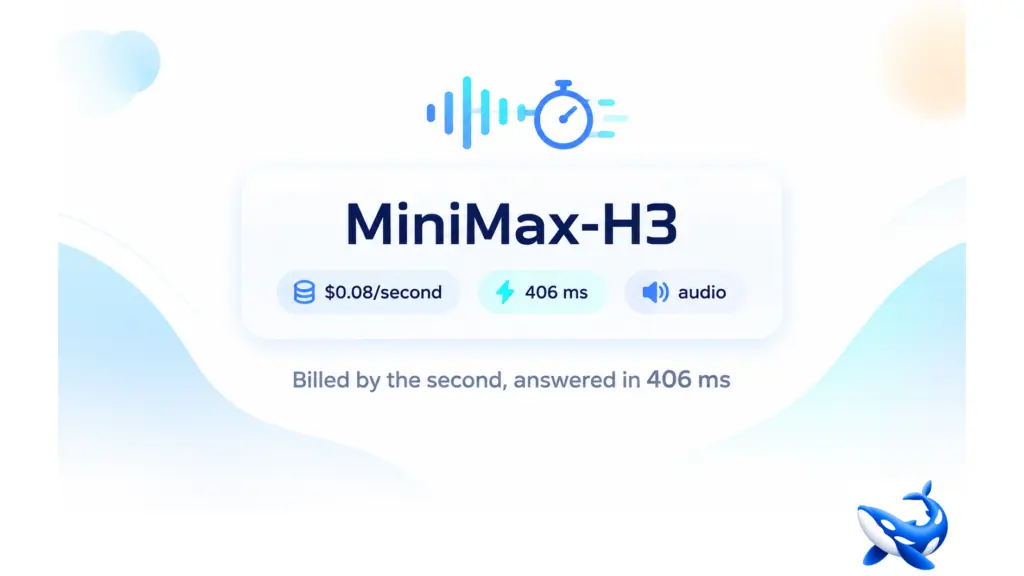
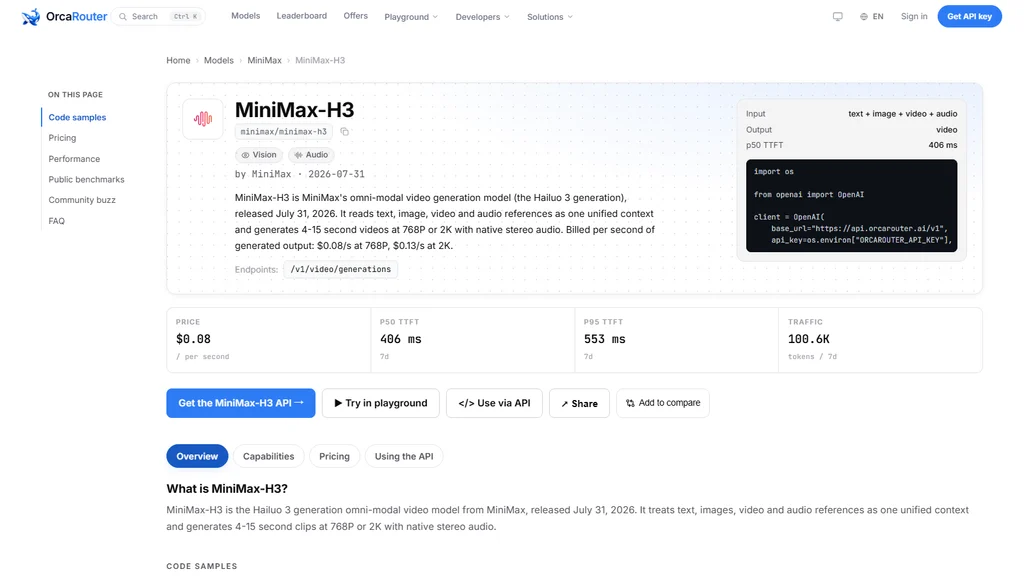
On OrcaRouter we host the MiniMax-H3 model — an audio model shipped on July 31, 2026, priced at $0.08 per second, a pricing shape this fleet almost never sees: text models bill per token, and this one bills by the second of audio. Its p50 time-to-first-token is 406 milliseconds, the fastest first response of any audio card on the linked platform. It has no page on Artificial Analysis, the independent benchmark site that tracks text models, and as an audio card it sits outside that board’s scope. It is carried at list price on the same key as every other model, with the live telemetry on the linked page.
Four hundred milliseconds to a first response and a bill that runs while the audio plays — this is a card whose whole design is legible in two numbers, and this article is about reading them together.
Priced by the second, not by the token
The $0.08-per-second rate is the first thing to understand, because it changes how cost is even estimated. For a text model, cost is a function of the tokens in and out; for MiniMax-H3, cost is a function of the *duration* of the audio produced — a thirty-second speech response is $2.40, a five-minute generation is $24, and silence or thinking time does not accumulate because the meter runs only while audio plays. The pricing shape rewards concise outputs in the same way token pricing rewards short generations, but it also means the cost estimate is a timing estimate, not a counting one.
The design is worth naming plainly: this is a price that scales with the product being bought. A voice response, a TTS pass, an audio-format output — whatever the workload produces, the bill is the runtime of that output. Teams building on it plan budgets in minutes of audio, not in tokens, and the linked page’s telemetry is the number that helps them: measured on the real endpoint, so the per-second meter has a production record behind it.
The fleet’s only audio card on the board
| card | kind | pricing | first response | AA page |
| MiniMax-H3 | audio | $0.08 / second | 406 ms | no page on AA |
| OrcaDub 1.0 | audio | $0.60 / minute | — | no AA (our product) |
| Kling 3.0 Turbo | video | $0.11 / request | — | no AA (video) |
Pricing shapes and first-response figures are from the linked pages; the audio cards have no page on Artificial Analysis because the board covers text models, and this article reports that plainly rather than treating it as a gap in the record. The table is the fleet’s only audio row set: MiniMax-H3 billed by the second against our own OrcaDub billed by the minute against a video card billed per request. Three different meters for three different products, and the comparison worth making is the design intent, not a head-to-head score — none of these three has one.
What a 406-millisecond first response buys
The p50 first token of 406 milliseconds is the fastest first response of any audio card on the linked platform, and for audio it is not a nicety — it is the difference between a voice experience that feels instant and one that feels like a phone tree. A human holds a pause of roughly half a second as natural; anything materially longer reads as the system thinking, and in a voice loop that gap is exactly where users interrupt, re-speak, or hang up. 406 milliseconds clears that bar with room to spare, which is the production finding that makes the card’s design real rather than a spec-sheet claim.
The honest context is what the number is not: it is a first-response latency, not an end-to-end answer time. The audio still has to finish playing — and under a per-second meter, the bill keeps running while it does. Teams should read the two numbers as a pair: the response starts in well under half a second, and the cost is the runtime of the output that follows. The linked page shows both, which is exactly the pairing a buyer needs.
It is also worth saying what 406 milliseconds does *not* require. That figure is a production p50 across real traffic — the model does not need a warmed cache, a simple prompt, or a text answer to hit it, and it holds even when the request is a full audio generation rather than a short utterance. That is what separates it from a marketing latency: a first-token number measured on the vendor’s demo endpoint can be cherry-picked, but a p50 over 100.6K weekly tokens of mixed workloads is the endpoint’s honest average. The reader should hold this card to the same standard the article holds every other card to: the number on the linked page, measured on the real endpoint, is the number to trust.
The voice workloads that fit
MiniMax-H3’s profile fits the workloads that want audio in and audio out, or audio out at speed: voice assistants and voice-loop agents, real-time TTS for IVR and in-app voice, audio-format responses where a text transcript would lose the product. For each, the 406-millisecond first response and the per-second meter are the two numbers that decide viability — can the loop feel instant, and can the budget absorb the runtime. The 100.6K weekly tokens on the linked page show teams already running those workloads against the real endpoint.
The discipline is the discipline of any time-metered product: keep the output as short as the job allows, because the meter runs while the audio plays. A voice assistant that answers in one crisp sentence costs a fraction of one that narrates. That is not a flaw in the card — it is its pricing model doing exactly what it was designed to do — and the teams that design their outputs to the meter get the cheapest voice loop on the board.
The takeaway
MiniMax-H3 is the fleet’s per-second audio card: $0.08 per second of audio, a p50 first response of 406 milliseconds — the fastest of any audio card on the linked platform — and 100.6K weekly tokens of production traffic. It has no page on Artificial Analysis, because that board covers text models, so no independent score exists to cite. Its pricing is the design: cost is a function of the audio runtime, and the meter runs only while audio plays. For voice workloads that need an instant first response and a predictable per-second bill, this is the card — live at list price, with the telemetry on the linked page.
Sourcing note: pricing shape ($0.08 per second) is what MiniMax lists and has not been independently reproduced. MiniMax-H3 has no page on Artificial Analysis as of 2026-10-08, so no independent score is cited. The p50 time-to-first-token and seven-day usage are OrcaRouter production telemetry from the linked model page. All checked 2026-10-08.
Also Read
