


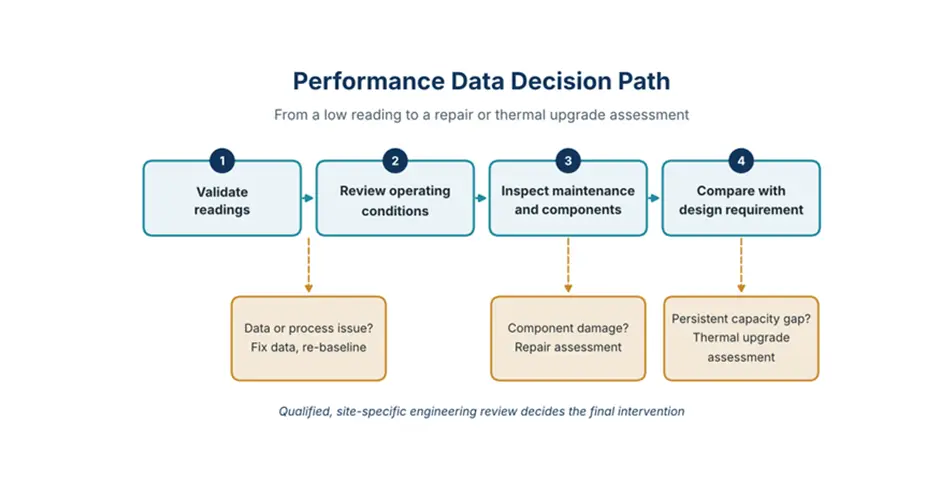
Repeated, verified performance data should trigger an assessment, not a single low reading. Start with comparable records of heat load, hot and cold water temperatures, ambient wet-bulb, water flow, and fan status. Then rule out sensor errors, process changes, and maintenance gaps.
If the tower still misses its required conditions, inspect the components. Verified component damage usually points toward cooling tower repair. A persistent gap after maintenance and repair points toward a qualified thermal upgrade assessment.
Why Performance Drift Needs Evidence Before a Capital Decision
One warm afternoon or one operator complaint does not diagnose a tower. Cooling tower performance changes with weather, heat load, and water flow, so a single reading can mislead.
A capital decision needs a stronger basis. Teams that buy new fill or fans on a hunch may fix the wrong problem, while the real cause stays in place.
A repeatable baseline solves this. It lets the team compare like with like and see whether cooling tower efficiency has truly declined.
Establish Comparable Operating Data
Performance data only helps when readings from different days describe similar conditions. Measurement methods depend on system design and available instrumentation, so each site needs its own practical approach.
Record Load, Water Temperatures, Wet-Bulb, Flow, and Fan/Pump State
Collect these readings at the same time whenever possible:
● Process heat load or production rate at the time of reading
● Hot water (inlet) and cold water (outlet) temperatures
● Ambient wet-bulb temperature, where an instrument provides it
● Circulating water flow
● Fan speed or status and the number of pumps and cells in service
Two calculated values help with comparison. The range equals hot water temperature minus cold water temperature. The approach equals cold water temperature minus ambient wet-bulb temperature, and a widening approach under similar conditions deserves attention.
Record Instruments, Timestamps, Units and Operating Conditions
Each reading needs context. Note the instrument, its location, the units, and the exact time. Also record unusual conditions, such as a cell offline for work or a process upset. Without these notes, a later reviewer cannot judge whether two readings truly compare.
Separate Data-Quality Issues From Equipment Issues
Before anyone blames the tower, check the data itself. The prompts below help a team find common non-equipment causes. They guide the review and do not explain every case.
● Sensor accuracy: Has anyone checked the calibration recently?
● Sensor placement: Does the probe sit where it measures mixed, representative water?
● Load changes: Did the process heat load rise since the baseline?
● Process changes: Did flow, set points, or connected equipment change?
● Recent maintenance: Did recent work change fan pitch, valves, or water flow?
● Fouling: Do the fill and nozzles show scale, debris, or biological growth?
● Visible distribution or airflow problems: Do dry fill areas, blocked louvers, or a stopped fan appear on a walk-down?
A “yes” to any prompt does not prove the cause. It tells the team what to verify before moving on.
Use Symptoms to Decide What to Investigate Next
Symptoms point to areas worth checking, not to proven failures. The table below links common observations to a next step. It serves as a starting point and does not replace a site inspection.
| Observation | Possible Areas to Investigate | Evidence to Collect | Who Should Review |
| Cold water temperature rises at similar load and weather | Fill condition, water distribution, airflow | Trended range and approach, fill and nozzle photos | Maintenance engineer |
| Uneven water pattern across the fill | Nozzles, distribution basins or headers | Walk-down photos, basin levels | Maintenance planner |
| Higher fan motor current or vibration | Fan, gearbox, drive shaft, motor | Current and vibration trends, oil analysis | Reliability engineer |
| Higher drift or carryover near the tower | Drift eliminators, water loading | Visual inspection, eliminator condition | Maintenance engineer |
| Tower misses required conditions after maintenance | Thermal capacity versus current duty | Verified baseline, design data, load history | Qualified cooling tower specialist |
When Maintenance or Component Repair May Be the Next Step
Many performance problems trace back to physical condition. When an inspection confirms clogged nozzles, damaged fill, worn drive parts, or failed eliminators, the evidence can support a repair work order.
The work order should reference the inspection findings, photos, and readings that justify it. Specific repair methods depend on the tower design, the OEM documentation, and site procedures. Work on fans or drives also requires the site’s energy isolation procedures and qualified personnel.
For site-specific repair and upgrade options, review ICS’s industrial cooling tower repair and upgrade services. After the repair, repeat the baseline readings under similar conditions to confirm whether performance recovered.
When a Thermal Upgrade Assessment May Be Justified
Sometimes the tower performs as designed, but the duty has changed. Production may have grown, or the process may now need colder water than the original design delivered.
A thermal upgrade assessment may make sense when the tower repeatedly misses required conditions after the team verifies the data and completes relevant maintenance and repairs. If the evidence points toward a thermal performance gap, review the relevant ICS information on cooling tower thermal upgrades.
The decision itself needs a site-specific engineering review. That review should compare alternatives, such as component upgrades, added cells, rebuilds, or replacement. Some owners also commission a field test under CTI ATC-105, the Cooling Technology Institute’s acceptance test code, to measure current capability against design.
Build a Decision Record Before Approving Spend
A decision record shows approvers what the team knows, what it assumes, and what remains uncertain. Include these elements:
● Baseline: The verified readings and the conditions behind them
● Target and design source: The required conditions and where they came from
● Assumptions: Load forecasts, weather conditions, and operating hours
● Measurement limits: Instrument accuracy and any missing data
● Options: Repair, upgrade, rebuild, or replacement alternatives
● Downtime constraints: Outage windows and cells available
● Cost quote: Written quotes with clear scope
● Risks: What could go wrong with each option
● Approval owner: The person who signs off on spend
Conclusion
Good decisions start with comparable, verified data. Rule out sensor and process issues, inspect the components, and then match the response to the evidence. Verified damage supports cooling tower repair, while a persistent capacity gap supports a qualified thermal upgrade assessment.
For a site-specific assessment, readers can contact ICS through its repair and upgrade service page.
Frequently Asked Questions
What readings should a team collect before assessing cooling tower performance?
Collect hot and cold water temperatures, ambient wet-bulb where available, water flow, heat load or production rate, and fan and pump status. Record each instrument, its location, units, and the time of reading. These details let the team compare readings across days and calculate range and approach on a consistent basis.
How can a team tell a maintenance issue from a thermal capacity problem?
Start by verifying the data and completing relevant maintenance, such as cleaning nozzles and checking fill condition. If performance recovers under similar conditions, the issue was likely maintenance. If the tower still misses required conditions at verified load and weather, the gap may reflect capacity, and a qualified assessment can confirm it.
Does one high cold water temperature reading mean the tower needs an upgrade?
No. A single reading can reflect hot, humid weather, a load spike, or a sensor error. Look first for a repeated pattern under comparable load and weather. Then check maintenance records and component condition. Only a persistent, verified gap justifies a thermal upgrade assessment, and that assessment still needs site-specific engineering review.
Also Read
