


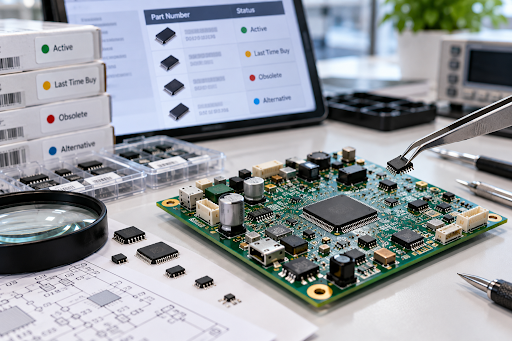
An electronic device can work perfectly for years, only to become difficult to repair when a small component eventually fails. The problem is not always the complexity of the repair itself. Sometimes, the original replacement part is simply no longer available. This is an important consideration in PCB assembly for electronic products, especially for devices expected to remain in use for many years. As products age, electronic component sourcing can become just as important as the original manufacturing process.
A Small Component Can Determine a Product’s Future
Consider a digital thermostat, industrial measuring device, or home security system that has been operating reliably for several years.
One day, a communication chip or power management component stops working. The rest of the circuit board may still be in excellent condition, but replacing the failed part becomes difficult.
Electronic components do not remain available forever.
Manufacturers regularly introduce new products, discontinue older components, and update their manufacturing technologies. A chip that was widely available when a device launched may be difficult to obtain several years later.
For companies supporting older products, this creates a practical challenge. The device may still have useful life remaining, but repairing it depends on finding a suitable component.
Why Replacing a Chip Is Not Always Simple
At first glance, replacing an unavailable component with a similar one seems straightforward.
If two chips have the same package and similar specifications, they might appear interchangeable.
However, compatibility involves more than physical dimensions.
A replacement may have different voltage requirements, communication behavior, timing characteristics, or software dependencies. Even a minor difference can affect how the finished product operates.
For example, replacing a sensor interface chip might change the way measurements are processed. A different power management component could influence startup behavior or efficiency.
Engineers must therefore evaluate replacements against the original circuit requirements rather than relying on appearance or basic specifications alone.
Product Design Influences Future Repair Options
Some electronic products are easier to maintain because their designs allow individual components or modules to be replaced.
Others use highly integrated circuits, proprietary parts, or compact assemblies that are difficult to service.
Neither approach is automatically better. Compact integration can reduce size and improve performance, while modular construction may make certain repairs easier.
The appropriate balance depends on the product’s purpose, expected service life, and cost requirements.
For equipment intended to operate for many years, designers may consider component availability, alternative part options, and maintenance requirements before finalizing the hardware.
These decisions can influence whether a future repair involves replacing one component, exchanging an entire circuit board, or redesigning part of the system.
Older Products Create New Manufacturing Challenges
Repairing an older electronic product is not always possible with the original manufacturing documentation alone.
The original PCB design may still be available, but some components could have been discontinued. Assembly processes, equipment, or material availability may also have changed.
If a company needs to produce replacement boards, engineers may have to review the bill of materials, confirm component availability, and evaluate any proposed substitutions.
In some cases, the existing design can be manufactured with minimal changes.
In others, a component replacement may require a PCB layout revision, firmware modification, or additional testing.
The challenge is to preserve the intended product behavior while adapting to the parts and processes available today.
Repairability Is Also a Business Decision
For manufacturers, supporting older electronic products involves balancing several factors.
Maintaining spare-part inventory costs money, particularly when demand is uncertain. Redesigning a discontinued circuit board can also require engineering resources and testing.
On the other hand, replacing an entire product because of one unavailable component may be expensive for customers.
This is especially relevant for industrial equipment, laboratory instruments, and specialized electronic systems that are expected to remain operational for extended periods.
Companies may choose to maintain replacement-board inventory, qualify alternative components, or plan periodic hardware updates.
The best approach depends on the product’s value, service commitments, and expected remaining lifetime.
Planning for the Next Generation of Components
Component availability is not something manufacturers can control completely.
However, product teams can make decisions that reduce unnecessary dependence on difficult-to-replace parts.
Maintaining accurate bills of materials, recording approved alternatives, monitoring component lifecycle information, and preserving design documentation can make future maintenance easier.
These practices are useful even when no immediate component shortage exists.
A well-documented product gives engineers more options when they eventually need to repair, reproduce, or update its electronics.
It also reduces the risk of making changes based on incomplete information about the original design.
Conclusion
Electronic products do not become obsolete only because their technology is outdated. Sometimes, a device remains useful while the components needed to maintain it become unavailable.
Long-term repairability depends on decisions made throughout product design, manufacturing, and maintenance.
By considering component availability, replacement compatibility, and future service requirements early, manufacturers can make electronic products easier to support as they age.
A circuit board may be built in a matter of days, but the decisions behind its components can influence the product for years.
Read more: https://rizways.com/boundaries-protect-integrity/
